
NPS Operations Manual for B2B
NPS Operations Manual - A B2B guide - Cover page
The reading rules, thresholds and formulas for running an NPS program on a portfolio of accounts, not a crowd of consumers. Published chapter by chapter, free, no form required.
Introduction
NPS is simple in principle, and that simplicity is precisely its value. It broke away from the long satisfaction forms that nobody completes anymore, and it did so while still saying a lot. But a simple principle does not mean a simplistic implementation. Between the question you send and a reading you can bring to a leadership table, there are rules, and most of them were never written down for B2B.
The reason is historical. NPS was born in the consumer world, where tens of thousands of anonymous respondents make an overall score meaningful and every vote can weigh the same. A B2B vendor lives in the opposite conditions: a few dozen to a few hundred accounts, unequal commercial weights, and several voices inside each account. Imported as is, the consumer reading does not just underperform in that world, it misleads, and a misleading first report is how NPS loses its credibility in front of a leadership team before it ever had a chance to prove its worth.
This manual is our attempt to write the missing operating instructions. It comes from the programs we run and repair at RIVVALUE, and it is organized the way an operator needs it: rules first, thresholds and formulas included, each chapter self-contained and applicable from the very next report. Nothing in it requires new software. The rules can be implemented in a spreadsheet by cross-referencing survey exports with CRM data, or with the help of an LLM, as long as you budget for some data analysis effort.
A new chapter is published every month on LinkedIn and added to this page. The assembled manual will be available here as a single document once the series is complete.
chapter list
Chapter 1 — The 5 rules for reading a B2B NPS
The starting set for any SMB opening its NPS practice or fixing one that underdelivers: segment before reading, weight by revenue, respect the volume floor, separate signal from noise, know who spoke. With the weighting formula and the volume thresholds.
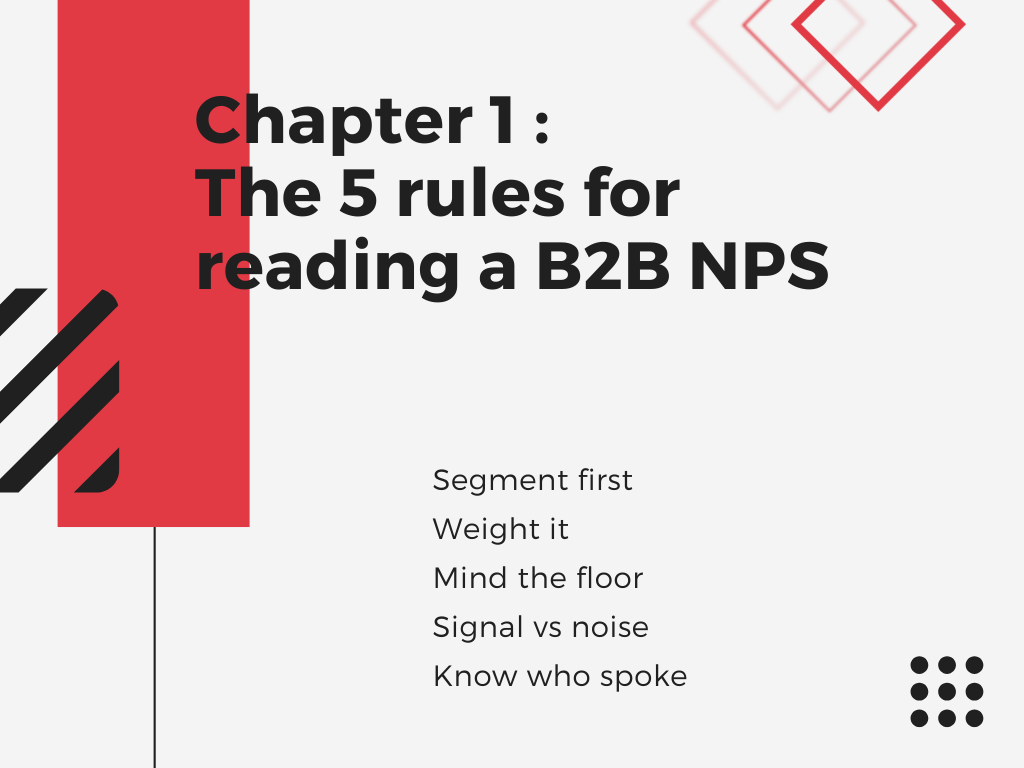
NPS Operations Manual for B2B - Chapter 1 - The 5 rules for reading a B2B NPS - Cover page
[Download: NPS Operations Manual - A B2B Guide - Chapter one - The 5 rules for reading a B2B NPS]
Chapter 2 — Relationship or transactional
The distinction that decides whether your score predicts anything, the three questions that name the right instrument, one golden rule, and the economics behind each, with the minimum setup for a vendor with up to 300 accounts.

Relationship or Transactional
[Download: NPS Operations Manual - A B2B Guide - Chapter two - Relationship or Transactional]
Chapter 3 — Who to survey: the respondent map of a B2B account
Users, managers, VPs and executives do not live the same product and do not vote for the same reasons. Building multi-role coverage of an account.

NPS for B2B - Who to survey inside an account
[Download: NPS Operations Manual - A B2B Guide - Chapter 3 - Who to survey inside an account]
Chapter 4 — Segment before you read: tier, value, tenure, industry (next)
The four cuts that matter, weighting by revenue rather than by headcount, and what a segment reading table looks like.
Chapter 5 — Who to compare your NPS to: the trap of public benchmarks in B2B (upcoming)
Why public NPS benchmarks mislead the moment you leave the consumer world: sample sizes, industries and methods that have nothing in common with a portfolio of accounts.
The only benchmark that holds in B2B is your own, and this chapter shows how to build it from your own measurements.
Chapter 6 — Cadence: measuring often enough without exhausting your accounts (upcoming)
Respondent fatigue, campaign windows, coordination with renewals and QBRs, and a vendor's typical annual calendar.
Chapter 7 — Response rate is not the goal: aim for signal quality (upcoming)
Completion versus response, what one rich verbatim is worth against ten mute scores, and honest B2B benchmarks.
Chapter 8 — Closing the loop: the 30 days after the measure (upcoming)
Where most programs die. Who calls which respondent back, within what delay, with what mandate, inside and outside the company.
Chapter 9 — From score to decision: making NPS speak in the boardroom (upcoming)
Presenting a segmented NPS to leadership, linking verbatim themes to product and commercial decisions.
Chapter 10 — Proving the value: linking NPS to renewal and expansion (upcoming)
The CFO chapter. Correlating score and retention by segment, the cost of a strategic detractor, and a simple model to quantify what the program protects.
About RIVVALUE
RIVVALUE is a Voice of Client intelligence partner for B2B, and the maker of VOÏA, the conversational Voice of Client platform, built for vendors who read their portfolio account by account.